"Pressure fluctuating after restart. Seal replacement didn't fix it. Found contamination near the valve assembly."
That's a technician's note from a maintenance log. Notes like it have been sitting in enterprise systems for years—alongside service reports, emails and shift handovers. Everyone knew the information was valuable. Almost nobody could use it systematically.
Much of the conversation today is about what GenAI and agents can replace. I'm more interested in what they can add to the Analytics and Machine Learning we already know works.
Take that technician's note.
GenAI can extract structured events, symptoms, interventions and outcomes. Those observations can then be linked to equipment, alarms, maintenance history and prior failures.
What comes out the other side isn't an answer—it's a column your model never had.
What I found harder wasn't building the model. It was reconstructing the meaning around the data—reconciling events across sources, identifying which records described the same failure, and turning years of human-written context into something the model could actually learn from.
The intelligence was already there. The difficult part was making it computable without losing what it meant.
Then hand that richer data back to the models that were always good at this part.
Eventually, every business decision becomes a number. Revenue. Forecasts. Remaining useful life. Failure probability. Inventory.
If the answer is 4.01, a plausible 4.02 isn't good enough.
The numbers have to reconcile.
Let Analytics find the patterns. Let the anomaly detector detect anomalies. Let the forecasting model forecast. Let the survival model estimate failure probability.
GenAI doesn't make these capabilities obsolete. It makes them more powerful by expanding the information available to them.
And then GenAI gets its second turn.
Take those analytical and ML outputs, combine them with business context and evidence, and communicate them differently to an engineer, a manager or an executive.
Explainable AI asks: Why did the model make this prediction?
GenAI answers a different question: What does this mean for me, and what should I do next?
So I don't see the evolution as:
Analytics → ML → GenAI
I see a loop:
GenAI → richer data → Analytics & ML → GenAI → Action → GenAI
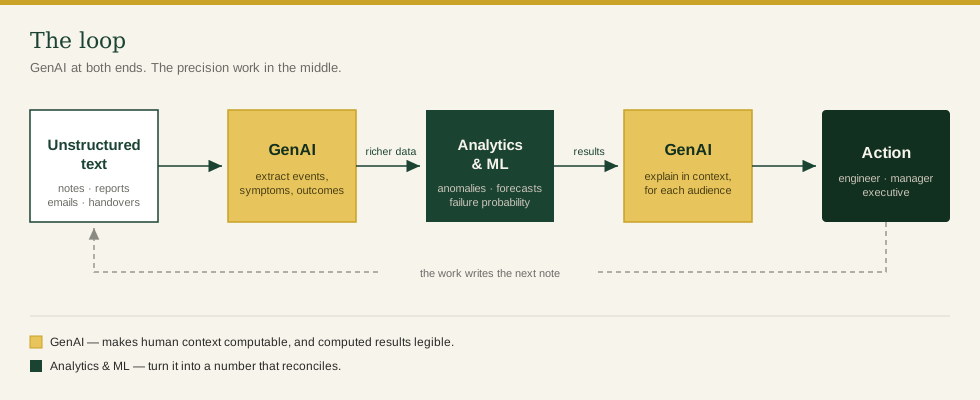
GenAI isn't making traditional Data Science obsolete. It's making existing business intelligence computable, expanding what Analytics and ML can see, and helping more people act on what those systems already know.