Ask most people what AI is today and they'll describe ChatGPT. Large language models, chatbots, image generators — the tools that arrived in the last couple of years have quietly become the definition of AI in the public mind.
That's the misconception. And it's worth correcting, because it shapes how people understand the entire field.
AI is older than ChatGPT
Artificial Intelligence is not two years old. It's a decades-old branch of computer science, and much of it has nothing to do with the generative tools dominating today's headlines. Symbolic logic, rule-based expert systems, knowledge graphs, search algorithms like A*, and operations research all existed long before modern generative AI. Many of these systems don't learn from data in the way machine learning models do, yet they are unquestionably part of AI.
AI is the broader pursuit of building systems that exhibit intelligent behaviour. Learning from data is one approach to achieving that — and today, it is by far the most successful and widely adopted one.
Once you see that, another common misconception starts to unravel.
The map most people are shown
You've probably seen diagrams showing Machine Learning inside AI, with Data Science floating somewhere outside, or nested circles trying to explain the relationship between the three. They're useful simplifications, but they don't accurately capture how these disciplines evolved.
Artificial Intelligence and Data Science emerged as two distinct disciplines with different goals.
Artificial Intelligence focuses on building systems capable of intelligent behaviour.
Data Science focuses on extracting knowledge, insights, and value from data.
A data scientist can spend an entire career working on exploratory analysis, statistics, experimentation, forecasting, and business intelligence without ever building an AI system. Likewise, AI has a rich history of techniques that don't rely on learning from data.
Where these two disciplines intersect, however, something remarkable happens.
That intersection is data analysis — using data to describe what has happened, and to predict what will happen next.
And this is where machine learning lives. Machine learning is a subset of data analysis: the part where the system learns those patterns directly from data instead of being handed explicit rules. Find structure in data with no labels to guide you, and you're doing unsupervised learning — the descriptive side. Learn from labelled examples to predict an outcome, and you're doing supervised learning — the predictive side. Almost everything that has followed is a deeper, more powerful form of that predictive core: deep learning, computer vision, and even large language models, which generate text by predicting one likely token after another.
That is the relationship. Not a simple hierarchy — an intersection.
Artificial Intelligence ∩ Data Science → Data Analysis → Machine Learning at its core
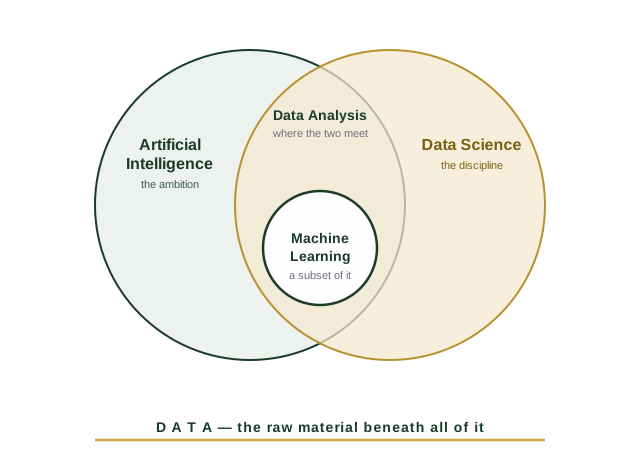
This is a lens, not the only valid picture. You'll still see the textbook diagram that nests machine learning inside AI as a sub-field — it isn't wrong, it's answering a different question. The intersection is the view that best explains how these fields actually grew, and why they keep colliding.
What all of it rests on
Arthur Samuel, credited with coining the term Machine Learning in 1959, is often paraphrased as calling it the field of study that gives computers the ability to learn without being explicitly programmed. But learn from what?
Data.
Remove the data, and machine learning doesn't merely become less effective — it stops working. The same principle extends to deep learning, large language models, generative AI, and many of today's agentic AI systems. No matter how sophisticated the architecture, the quality of the outcome is fundamentally constrained by the quality of the data behind it.
That's why treating these terms as interchangeable can be costly. When we mistake an entire discipline for its most fashionable technology, we end up chasing tools instead of understanding the landscape. The tools will continue to evolve. New architectures will appear. New job titles will emerge.
The labels will change. But the ground they stand on shifts far more slowly.
The most durable thing you can learn in this field isn't a tool or a title. It's the shape of the landscape itself — and the one ingredient every part of it depends on.
Want the bigger picture?
This article explains how Data Science, Machine Learning, and Artificial Intelligence relate. But these are only three parts of a much larger landscape.
To understand how enterprise data systems evolved into today's AI ecosystem — and why disciplines such as Data Engineering, MLOps, Generative AI, and Agentic AI emerged along the way — read my free guide:
I wrote the original version of this piece on the Brillersys blog in 2024. This is my rewritten and expanded take.