I gave it one page.
Years ago, before agent became common vocabulary, I built what today we would call a virtual software team. A project manager, a frontend developer, a backend developer and a tester. Each one had a role, passing work from one to another.
An hour later I had working software.
Not a mockup.
It ran.
So when I see someone post that they built an application over a weekend using AI, I believe them.
I have done it.
What I would add is what happened next.
Nothing in that page said who was allowed to see what. Or what happens when two people edit the same record. Or how a real organisation is structured, which turned out to be nothing like the one I had imagined. Or what the system should do when it is wrong.
Those were not omissions.
They were decisions nobody had made yet.
They were not coding problems. They were product decisions.
A one-page specification is not a smaller product. It is simply the part of the product someone has already thought through.
That is the first engineering. Then everything that was not on the page starts arriving.
Authentication. Roles and permissions. Multi-tenancy. A data model that survives the second customer. Audit trails. Notifications that reach the right person. Error recovery. Observability. A deployment pipeline. Security review. Migrations, because the first schema was wrong. Documentation, because somebody other than you has to run it.
And when the product includes AI, add evaluation, governance, monitoring and drift detection. People do not trust systems they cannot measure or explain.
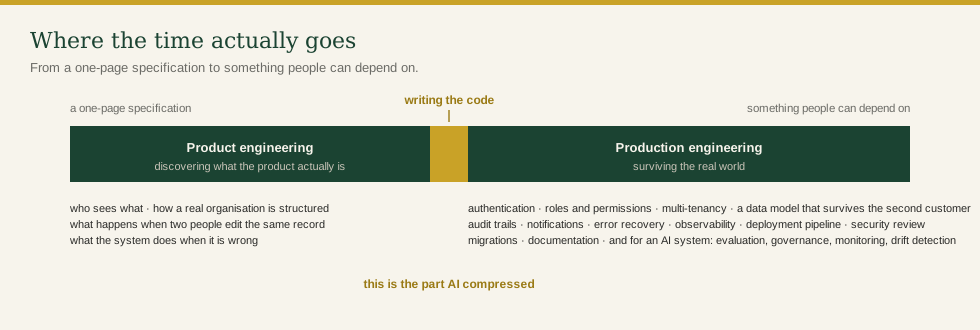
AI compressed the part that was never the bottleneck.
Writing code looked like the constraint because it was the visible part. You could count it, estimate it and watch it happen.
The invisible work, deciding what should exist, and then making it survive contact with a real customer, was always the longer half.
It just never looked like work.
So I do not think AI reduces the need for engineers.
It reduces the need for engineers whose primary value is translating requirements into code.
Building software became dramatically easier. Building products did not. Taking them to production did not either.