Give a vision team a big accelerator and their problem is choice. Dozens of models, open and proprietary. Even a language model runs.
Take the accelerator away, down to an ARM Cortex-A core with no NPU, and the menu is almost empty.
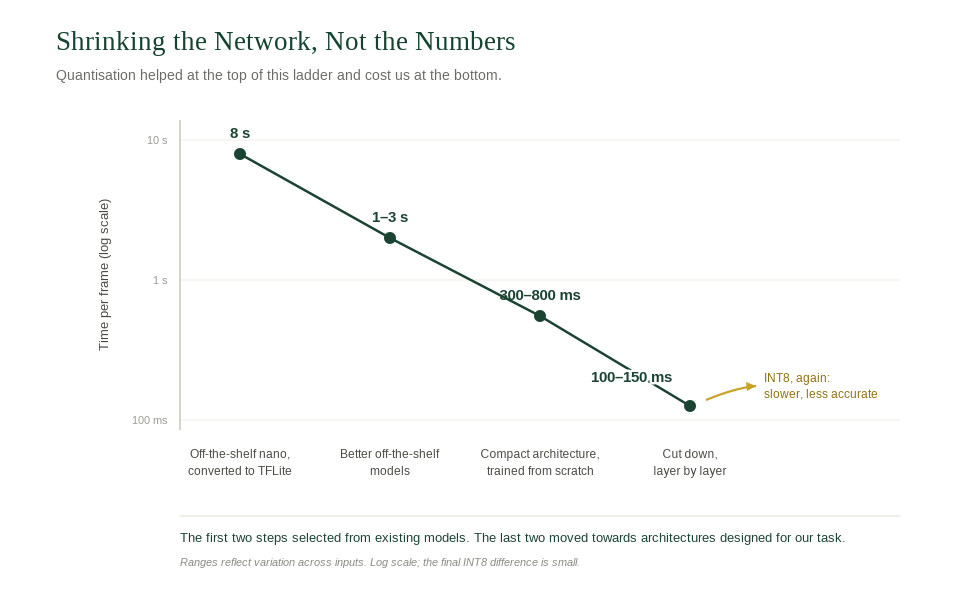
We started where everyone starts: off-the-shelf nano models, converted to TFLite. Eight seconds a frame. Shopping around for better off-the-shelf options brought that down to one to three seconds.
The standard next move is to quantise to INT8. Four times smaller in weight storage, so it should be faster. On a full MobileNetV3 it did help, a little. Not enough.
There are reasons. Some compact architectures are particularly sensitive to INT8 quantisation. And smaller weights do not automatically mean faster inference. The result depends on the operators, the CPU and the runtime.
Our preprocessing alone took 99 ms, most of it a per-channel Python loop. Vectorising it, with a few smaller fixes, took almost all of that back.
But the model was still too slow.
So we stopped shrinking the numbers and started shrinking the network.
We moved to smaller architectures based on MobileNetV3, trained on our own data. That brought latency down to 300-800 ms.
Then we cut further. We removed computation the task did not need, deliberately, layer by layer.
The cuts were unglamorous. Fewer layers. Narrower ones. Widths sized for the handful of classes we actually had, rather than the thousand the original architecture was designed to handle. On one network the parameter count came down by about six times.
That took us to 100-150 ms.
The price was the pretrained weights.
Keeping those weights meant keeping too much of the architecture. Once we changed its structure, the original weights were no longer compatible. Everything had to be trained from scratch.
And pretrained weights are a gift. Someone else has already spent the data and the compute. Giving them up means owning all of it: the dataset, the training budget, and the risk that the smaller network never learns the task.
Ours did. On the task we measured, accuracy stayed above 98 per cent, close enough to the off-the-shelf baseline for our application.
We tried INT8 on the reduced network too. It came out slightly slower, and less accurate. There was nothing left for it to save.
Quantisation was not the strategy. It was the cheapest thing to try first, which is not the same thing.
On small silicon, the pretrained weights can be the thing holding you back.