The first sign wasn't in the data.
It was on the shop floor.
Operators had stopped looking at the control chart. Not because they distrusted statistics. Because it alarmed too often to be worth checking. False alarms became common enough that people learnt to ignore them, and once that happens the anomaly detector has already failed, whether or not the mathematics is correct.
The obvious reaction is to tune the thresholds. We looked somewhere else.
Western Electric Rules work best when the process is reasonably stable and approximately normal. Most of the attention goes to Rule 1, a point outside 3σ. But the stronger assumptions live elsewhere.
Rules 2, 3 and 4 partition the 1σ and 2σ regions into patterns that only carry their intended statistical meaning if those regions behave the way a normal distribution says they should.
Ours didn't.
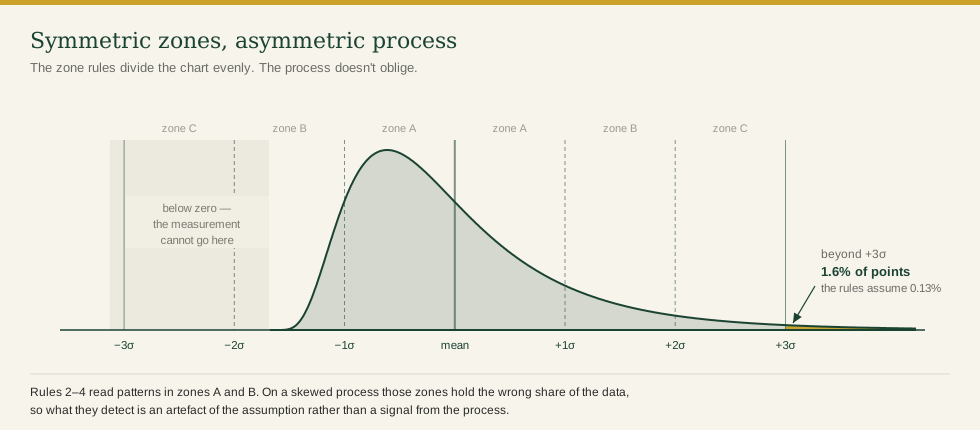
The distribution wasn't symmetric. Operating conditions changed. The baseline moved.
Every production change looked like a process excursion. Every shift change looked like a statistical signal. Eventually the alarms stopped meaning anything.
The chart wasn't wrong. The assumptions behind it were.
So we simplified.
We kept Rule 1.
Everything else went.
Instead of fixed limits, we recalculated the mean and standard deviation continuously, using a rolling window matched to how each process actually behaved. For some, that meant the last 24 hours, updated hourly. For others, the last 7 days, updated daily.
False alarms dropped. More importantly, people started trusting the alarms again.
Of course, that created a new problem.
A trailing window slowly absorbs drift. What used to be an anomaly gradually becomes the new normal.
Drift became its own engineering problem, separate from the rolling limits. Part of the verified drift updated the baseline; sudden excursions still had to prove themselves against it.
Instead of asking one algorithm to detect every kind of abnormal behaviour, we let each mechanism do what it was best suited for.
We hadn't eliminated the trade-off. We'd moved it somewhere we could engineer around it.
Looking back, the lesson wasn't really about Western Electric Rules.
It was about assumptions.
We spend a lot of time choosing algorithms, and much less time asking whether the assumptions behind them actually describe the system we're monitoring.
Sometimes the best engineering decision isn't finding a more sophisticated method. It's removing an assumption reality never agreed to.
In the end, we didn't win the argument about Western Electric Rules. We made the argument unnecessary.